How X’s “Made with AI” Label Actually Works
What puts a “Made with AI” label on an X post: the disclosure toggle, automatic upload detection, Grok’s watermark, and what X has and has not documented.
X rolled out its “Made with AI” label in late February and early March 2026. A post can end up with it in exactly two ways: you switch it on yourself, or X switches it on when you attach the media and locks it there. The first path is straightforward. The second is where most of the confusion lives, because X has not published a help article explaining what its detection reads. This guide separates what X has documented, what independent testing shows, and what is still unknown as of September 2026.
Where the label shows up
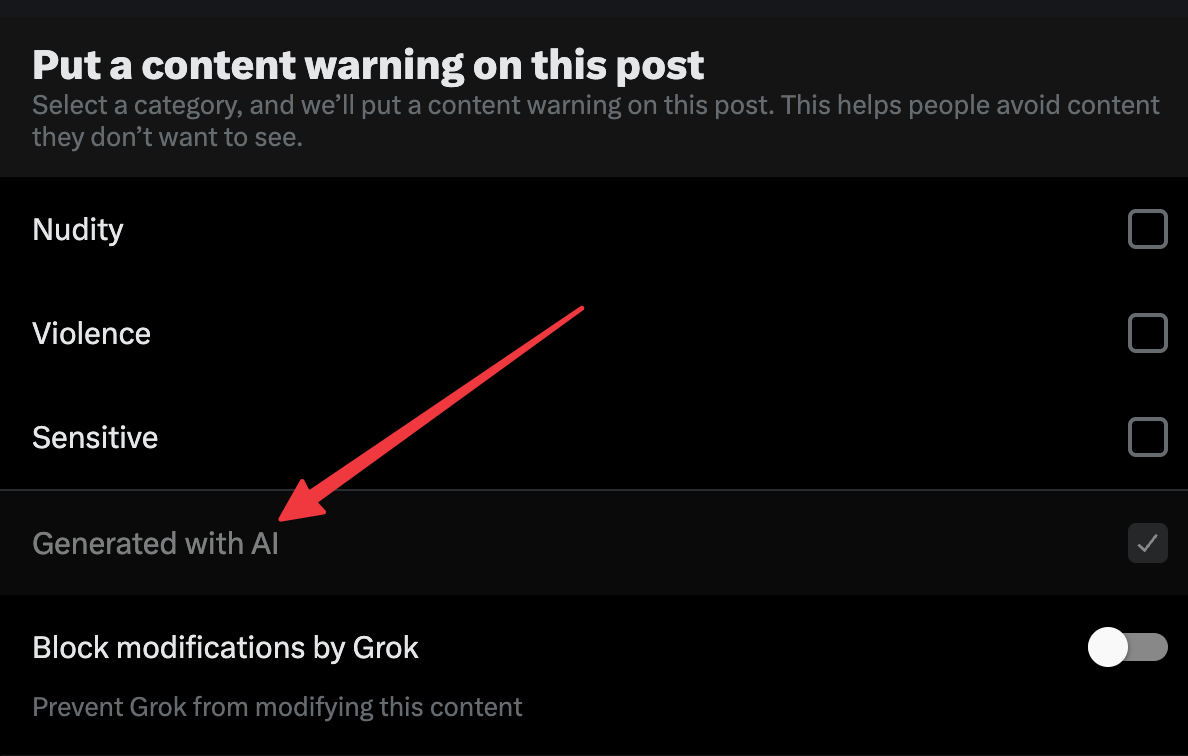
In the composer, a “Made with AI” line with a sparkle icon appears under an attached image, next to “Tag people” and “Add description.” The flag icon on the media opens a content-warning panel with Nudity, Violence, and Sensitive categories, a “Generated with AI” entry, and a separate “Block modifications by Grok” switch. At launch, reporting also described a post-level “Content disclosure” panel with two toggles, “Paid partnership” and “Made with AI,” the latter described as marking the post as containing synthetically generated content. Once published, the label sits under the post.
Path one: you disclose it
The self-applied label behaves like any other post setting. You can switch it on while composing, and testers report it can be added or removed afterwards from the post’s menu. X’s written rules are thinner than the feature. The one explicit AI-labeling requirement we found is in the creator monetization standards: creators must add a clear disclosure to AI-generated content depicting armed conflict, a rule X announced in March 2026. Beyond that, X’s Authenticity policy prohibits misleading media that may cause widespread confusion or serious harm, AI-generated or not.
Path two: X detects it at upload
When X flags an upload, a toast reading “AI-generated content detected” appears and the label is locked on. A researcher spotted that this toast’s internal name in the app is COMPOSE_VIEW_C2PA_AI_DETECTED_TOAST, which is the strongest public hint that C2PA Content Credentials are one input. X itself has not said so. The results are also not what a simple C2PA check would produce: in a March 2026 test, a ChatGPT image was labeled while Gemini and Grok images were not, even though Gemini output also carries C2PA. The same write-up notes other users reporting labels on Gemini images and on images made without AI.
Edits count too. An Adobe community thread reports the label appearing on a real photograph after Lightroom’s generative Remove tool was used. That fits how provenance works: edit tools can declare that part of an image was changed with generative AI, which the IPTC Digital Source Type vocabulary records separately from a fully generated image. Whether X distinguishes the two, it has not said.
| Signal | Status | What we know |
|---|---|---|
| Your own toggle | Documented | Added in the composer or later from the post menu, and removable if you added it |
| C2PA Content Credentials in the upload | Likely, not confirmed | Inferred from the app’s internal toast name; automatic labels are locked |
| IPTC digital source type metadata | Unknown | X has not said whether it reads the XMP field on its own |
| Invisible watermarks such as SynthID | Unknown | Not mentioned by X; Gemini images went unlabeled in the March test |
| Grok’s visible watermark | Not a trigger in testing | Grok images were not auto-labeled in the March test |
Grok images: watermarked, not necessarily labeled
xAI’s Grok FAQ is plain about its own output: generated images and videos “include a Grok watermark to indicate that the content was created with AI,” there is no setting to turn it off, and removing or obscuring it or “other provenance signals” is prohibited by xAI’s Acceptable Use Policy. The FAQ does not mention C2PA or an invisible watermark, and we found no first-party documentation of either. That is consistent with the test above, where a Grok image did not trigger X’s automatic label.
The “Block modifications by Grok” switch in the same panel is a different control. It appeared in March 2026, after the January controversy over Grok editing photos of real people, and it stops Grok from editing that specific image. It does not label anything.
Other AI signals on X that are not this label
- Community Notes on media. Since May 2023, a note written about an image can attach automatically to recent and future posts that reuse the same image. It is a crowd-sourced context note, not the “Made with AI” label.
- Edited-visuals warnings. In January 2026 Elon Musk shared a new warning for manipulated visuals. X has not published the criteria it uses.
- Misleading-media enforcement. The current Authenticity policy lists reach restrictions and account actions for misleading media. Earlier versions also listed labels; the current text does not.
- EU-facing commitments. X’s media literacy action plan, published for Ireland’s Online Safety Code, says it has expanded labeling for AI-generated media, including “Made with AI” indicators, for users in the EU.
Does X read C2PA at all?
Twitter joined the C2PA steering committee in 2021. Reporting in early 2026 said X no longer appeared among members; as of September 2026 the C2PA membership page lists X as a Contributor Member, with no public announcement we could find. X does not document whether the files it serves keep EXIF, XMP, or Content Credentials, so do not assume a downloaded copy of your post still carries what you uploaded. For a map of how the other platforms handle the same signals, see AI labels on social platforms.
If you post AI images you own
- Know what the file carries. Check it at contentcredentials.org/verify and read its XMP. ChatGPT and recent Gemini images typically carry C2PA, and both can also carry an embedded SynthID signal that no metadata tool touches.
- Disclose when it matters. The toggle costs nothing, and for AI content about armed conflict it is required if you monetize.
- Do not treat metadata as the switch. Clearing provenance for privacy or a re-edit is routine (our C2PA removal flow does it), but X has not said what its detection reads, so a clean file is not a predictable label outcome.
- Expect change. The feature is months old, undocumented, and has already behaved differently across generators.
Primary sources
Technical and policy claims in this guide were reviewed against these references.
- X Help Center: Authenticity policy
- X Help Center: Creator monetization standards
- X Help Center: Media literacy action plan
- xAI: Grok FAQ (Grok Imagine watermark)
- C2PA: current membership list
- C2PA: Twitter joins the steering committee (2021)
- Roboin: testing when X applies “Made with AI” (March 2026)
- Social Media Today: X tests AI content labels (February 2026)
- TechCrunch: Musk teases an edited-visuals warning (January 2026)
- C2PA technical specification
Last reviewed September 28, 2026. This guide is general product and publishing information, not legal advice.